At this stage, arts and crafts are less about creating a “perfect product” and more about the process of exploration, sensory development, and fine motor control.
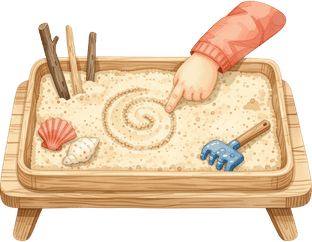
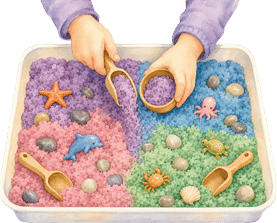
Media and Materials: Children explore different textures and mediums, including finger painting, watercolours and playdough
Fine Motor Skills: Learning to safely use kid-friendly toolsto build hand strength.
Color and Shape Mastery: Experimenting with color mixing and creating patterns using basic geometric shapes.
Imaginative Expression: Creating artwork that represents their own thoughts, feelings, or stories.
In EYFS, this is a core area called Physical Development (PD). The objective at the Kindergarten level is to build fundamental movement skills, spatial awareness, and a positive attitude toward active lifestyles.
Gross Motor Skills: Mastering core body movements including running, jumping and hopping on one foot
Object Control: Learning the basics of hand-eye coordination by rolling, throwing, catching, kicking, and bouncing large, soft balls or beanbags.
Spatial Awareness: Learning how to move safely within a shared space without bumping into peers, understanding concepts like “under,” “over,” “through,” and “around.”
Cooperative Play: Playing simple group games that introduce the concept of taking turns, following simple rules, and working together as a team.
SEN education in EYFS/KG is not a separate subject taught to children; rather, it is a highly individualized framework of inclusive support, tailored interventions, and environmental adaptations to ensure children with developmental, physical, or learning differences can access the curriculum.
Communication & Language Support: Utilizing visual aids, picture communication cards and simplified sign languageto help non-verbal or speech-delayed children express themselves.
Sensory Regulation: Providing sensory breaks, fidget tools, noise-canceling headphones, or dedicated “quiet corners” for neurodivergent children (e.g., those on the Autism spectrum or with ADHD) who experience sensory overload.
Differentiated Fine/Gross Motor Tasks: Adapting physical activities—such as providing thick, easy-grip crayons for children with low muscle tone.
Social-Emotional Interventions: Teaching emotional literacy through visual emotion cards, structured peer-play tracking, and guided transition routines to help children who struggle with changes in the school day.